Canada-Quebec agreement will fund rural transit projects while drawing attention to Lower Laurentian manufacturers
By Matthew Daldalian, LJI Reporter
Announcement puts transit with industry
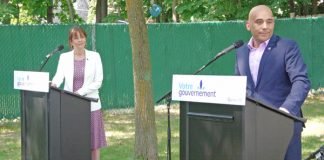
A new Canada-Quebec transit agreement announced in Saint-Eustache has been presented as a mobility investment for rural communities and a chance to highlight the Lower Laurentians’ role in bus manufacturing and regional industry.
The agreement, announced April 10 by the federal and Quebec governments, will provide $6.7 million for projects in 14 Quebec communities under the Rural Transit Solutions Fund. The money is meant to support the planning and implementation of public transit infrastructure adapted to the needs of rural and regional communities.
For Linda Lapointe, MP for Rivière-des-Mille-Îles, the announcement was also an opportunity to point federal decision-makers toward Saint-Eustache’s manufacturing base, including Nova Bus.
The Rural Transit Solutions Fund supports locally driven transit options in rural, remote, Indigenous and Northern communities, including fixed routes, on-demand transit and micromobility services such as e-bikes. The federal program is intended to help residents reach work, school, medical appointments, services and loved ones.
Regional mobility remains a challenge
Although the North Shore and Lower Laurentians are connected to Montreal through commuter routes, Lapointe said transportation between municipalities remains harder for residents who do not have easy access to a car or direct transit routes.
“It is very important because here on the [Lower Laurentians], it is not so easy to transport between municipalities,” Lapointe said to The North Shore News. “On the [Lower Laurentians], it is easy to go to Montreal if you have the electric train and then the buses, but inside it is more difficult.”
That gap is the kind of issue the agreement is supposed to address. Rural and regional transit projects can include fixed-route service, flexible routes, demand-response transit, community shuttles and mobility-as-a-service models. The fund can also support vehicles and infrastructure connected to those services.
The agreement was signed by Canada and Quebec to deliver Rural Transit Solutions Fund money in a way aligned with Quebec priorities. Both the planning and capital project streams of the program are currently closed, according to the federal government.
Gregor Robertson, federal Minister of Housing and Infrastructure, said the agreement is meant to strengthen transit networks outside major urban centres.
“We’re proud to deliver on investments that strengthen transportation networks in Quebec’s rural and remote communities,” Robertson said. “By working together, we’re building our communities strong.”
Nova Bus placed in spotlight
Lapointe said bringing Robertson to Saint-Eustache was important because his portfolio includes infrastructure and federal transfers tied to transportation.
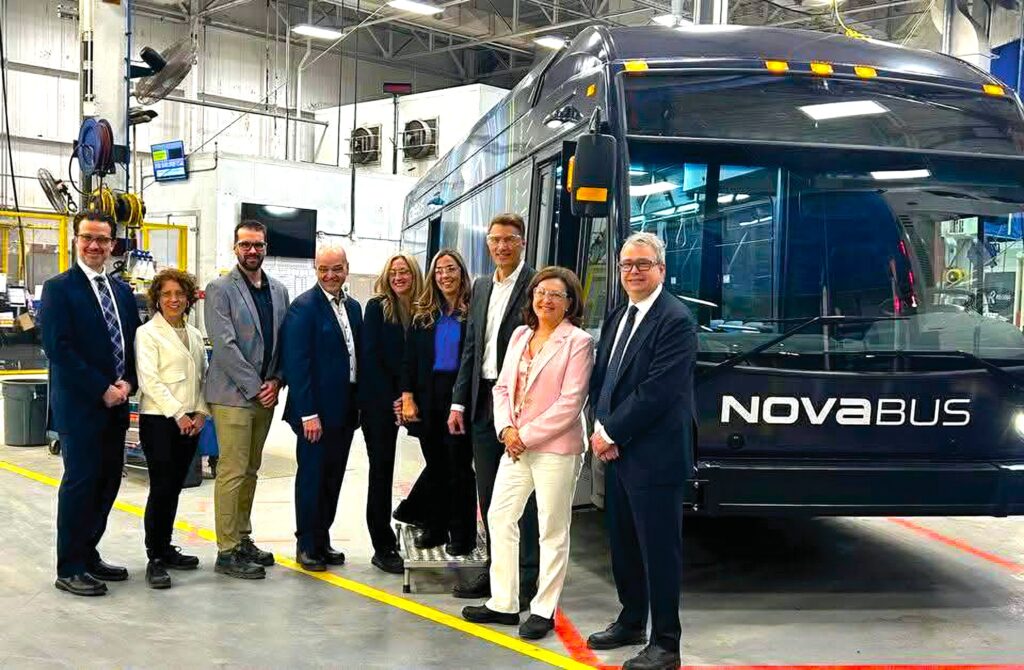
“To have the Minister Robertson with us, it’s to show him what we have as the manufacturer of Novabus,” Lapointe said. “In Canada there’s only two places that we built buses. The first one is in Winnipeg and the second one is in Saint-Eustache.”
Nova Bus, headquartered in Saint-Eustache, manufactures diesel, hybrid and electric public transit buses. Lapointe said the company’s presence gives the region a direct connection to the public transit sector being supported by infrastructure dollars.
She said the visit was meant to make clear that transportation investment is not only about service routes, but also about the workers and suppliers tied to vehicle production.
“For me it was very important to show that to [Robertson],” she said.
Quebec says funding adds to existing programs
Quebec Transport and Sustainable Mobility Minister Jonatan Julien said the agreement builds on provincial work already underway to improve transit outside major cities.
“For several years, the Government of Quebec has been investing to improve rural public transit to meet mobility needs across all regions,” Julien said. “The agreement reached today adds federal funding to our existing efforts through our regional public transit assistance programs.”
Quebec supports rural public transportation through programs such as the Programme d’aide au développement du transport collectif and the Programme d’aide au transport collectif régional. Regional organizations may also be eligible for public transit capital project programs administered through Quebec infrastructure and transit funding mechanisms.
For local communities, the practical outcome will depend on which projects are selected and how they are implemented. The federal release said rural communities may explore solutions such as fixed routes, on-demand service and mobility services including e-bikes.
Supply chain impact
Lapointe said the local impact of transit and infrastructure spending extends beyond a single manufacturer.
“If you sell buses, it’s not only the buses, it’s all the supply chain beside that,” she said.
She added that many small and medium-sized businesses contribute to major manufacturers by providing parts, services and support.
“So it’s more than just a business,” Lapointe said. “It’s not only Novabus, you have to add all the supply chain.”
Lapointe also linked the issue to larger federal spending priorities, including defence, manufacturing and procurement. She said businesses in the Lower Laurentians could benefit when federal departments buy vehicles, renovate facilities or invest in mobility-related equipment.
MP pushes regional visibility
Lapointe said she regularly uses her role in Ottawa, including on the trade committee, to promote businesses in the Lower Laurentians.
“I want to be sure that in Quebec and the rest of Canada, they know what we have to offer,” she said.
She mentioned companies in manufacturing, construction and agri-food as examples of regional strengths she raises when speaking with federal colleagues.
The Rural Transit Solutions Fund is not limited to buses or large infrastructure. It can also support planning work, design activities and smaller mobility tools that help people move within rural and regional areas. Its ultimate goal is to make communities more connected and reduce dependence on personal vehicles.
Joël Lightbound, federal Quebec lieutenant, said the agreement is also tied to economic stability.
“Intergovernmental collaboration and understanding helps us Build Canada Strong, prioritizing the economy, and enabling businesses to thrive amid global economic uncertainty,” Lightbound said in a release. “This agreement will help support rural communities by investing in local transit solutions that fit their needs.”
For the North Shore, Lapointe said the message is simple: improving transit and recognizing the region’s industry should happen together.
“This is made here in the [Lower Laurentians],” she said. “In my riding.”