Home Blog Page 7

RIPTB issues two updates on public-safety operations

0

The Régie intermunicipale de police Thérèse-De Blainville (RIPTB) has released two separate advisories to the public in late October and early November 2025, reporting on parallel public-safety concerns in its service territory.

Disorder at Parc Lorraine

On 23 October 2025, RIPTB notified the public that over recent weeks it had received several calls and information regarding a group of individuals who were causing disorder at Parc Lorraine in the municipality of Lorraine. According to the notice, the situation had generated concern among local residents.

In response, the police service says it has taken concrete steps: several arrests were carried out in connection with various acts of mischief and fires that occurred in different locations across the territory. The investigation remains ongoing and additional arrests are expected. The RIPTB is working closely with the City of Lorraine to restore a sense of safety and tranquillity. Key measures already in place include:

Regular and targeted patrols in the affected sectors.

Involvement of the intelligence and police-analysis unit to clarify the problem, which the RIPTB says extends beyond Lorraine’s municipal boundaries.

Efforts by the investigations bureau and the prevention department to identify more than twenty individuals involved in the misconduct.

The RIPTB emphasises that proactive policing continues, and the cooperation of citizens remains essential.

Pedestrian-vehicle collision on Boulevard Curé-Labelle

On 2 November 2025, the RIPTB confirmed that a serious accident involving a vehicle and a pedestrian occurred at approximately 8:35 a.m. on Boulevard Curé-Labelle in Sainte-Thérèse. According to first findings, a man in his sixties who was walking was struck by a car and transported to hospital with injuries described as serious. The driver was also conveyed to hospital as a precaution.

Inspectress-Chief Karine Desaulniers noted that the causes and circumstances of the collision remain to be determined. Investigators from RIPTB, supported by a collision-investigation technician from the Sûreté du Québec, will examine the scene thoroughly and interview witnesses. As a result of the intervention, a southbound lane of Boulevard Curé-Labelle was closed temporarily; motorists are asked to proceed with caution and observe the temporary signage.

For additional information, members of the public are invited to contact the communications service of the RIPTB.

Honouring Our Everyday Heroes: School Crossing Guards Recognized Across the Region

0

The Régie de police du Lac des Deux-Montagnes (RPLDM) proudly took part in the very first National School Crossing Guard Appreciation Week, which was held from October 27 to November 2, 2025. The initiative highlighted the vital contribution of the men and women who, every day, ensured that children travelled safely to and from school.

Guardians of Our Crosswalks

Crossing guards played a crucial role in school-zone safety. Beyond helping students cross streets, they acted as the first line of prevention against accidents, calmly reminding motorists and pedestrians alike of traffic laws and safe behaviour. Their steady presence helped build an atmosphere of trust, discipline, and mutual respect around schools, values that continue to resonate within the community.

Teaching Safety by Example

The mission of a crossing guard was not only protective but also educational. Through daily interactions with students, parents, and school staff, they raised awareness about road safety and encouraged lasting habits among young pedestrians. Whether in rain, wind, or snow, they demonstrated what it means to serve with dedication and care.

A Week of Appreciation

Throughout the week, officers from the Régie de police du Lac des Deux-Montagnes visited crossing guards across their territory to personally thank them for their commitment. Each visit came with a small token of gratitude: a warm coffee and a muffin.

The RPLDM’s gesture underlined the community’s appreciation for these everyday heroes whose vigilance and kindness continue to make a real difference in the lives of children and families.

From Westram to Pitre, what’s next for Rosemère?

As Marie-Élaine Pitre prepares to take office, outgoing mayor Éric Westram reflects on eight years of leadership

By Matthew Daldalian

As Rosemère’s newly elected mayor Marie-Élaine Pitre prepares to be sworn in with her six-member Vision Rosemère team on Monday, Nov. 10, the town is closing a political era, and beginning another.

Pitre’s win on Nov. 2 capped a decisive election that ended Éric Westram’s eight-year run as mayor.

The new mayor represents a generational handover in a community where, as she put it, “people are quite older.”

Marie-Élaine Pitre, Rosemère’s newly elected mayor, will be sworn in with her Vision Rosemère team on November 10 (Courtesy City of Rosemère)

“I feel that it’s a collective expression of trust,” Pitre said. “People have put their trust in us, and this is awesome.”

She believed her team’s positive and issue-driven campaign stood out amid the regular noise of local politics.

“People showed that they want human politics,” Pitre said. “We worked really hard to make sure that we were doing it, showing our ideas.”

Within days of taking office, Pitre said her administration will dive straight into the 2026 budget process while setting priorities around redevelopment, climate resilience and citizen services.

“We have Place Rosemère, it’s a big issue that we want to work on,” she said. “We also have to take care of our citizens and protect them against climate change.”

Her first months will test how quickly Vision Rosemère, which won all six council seats, can translate its unity into action.

Pitre claimed internal respect will guide council debates even without opposition members. “We don’t have the same ideas on everything all the time,” she said. “But we are able to debate in a respectful way and always in the interest of everyone.”

For Éric Westram, who led the town through two mandates beginning in 2017, the handover brings both introspection and relief. In an interview after his defeat, he said the result reflected a “wave of change” that extended beyond Rosemère.

“People up to a certain point think that a change is a necessity,” he said. “Maybe without even thinking it all the way through.”

The outgoing mayor, who spent 20 years in elected office and 45 years as a resident, said his campaign was straightforward and focused on experience and fiscal discipline.

“It was very simple, but it was straight to the point,” Westram said. “We wrote and said exactly what we wanted to do.” 

Westram attributed part of his loss to frustration with long-running local disputes. Most notably over the former golf-course property. He said the debate overshadowed other priorities and invited what he referred to as “propaganda” and “false information” online.

“It has become the focus point of the election, unfortunately,” he said. “There’s way more other things to look at and to decide than this situation on the golf course.”

Westram said he plans to step back from political life but remain active in the community he helped lead for nearly a decade. 

Outgoing Mayor Éric Westram said he plans to step back from political life (Courtesy city of Rosemère)

The outgoing mayor spoke with emotion about saying goodbye to municipal staff and residents. “I have a lot of respect for the people that work for the city of Rosemère,” Westram said. “If you didn’t have those employees… the city is more than just removing snow and collecting garbage.”

As for what comes next, Westr bn7am said he’ll take it “one day at a time,” potentially dividing his days between coaching soccer, tending his garden and, for the first time in years, watching council meetings as a citizen. 

“Life is life,” he said. “One day you’re a hero, next day you’re pushed aside, and I have to respect that choice.”

With her swearing-in set for Nov. 10, Pitre now inherits both the expectations and unfinished files of her predecessor. 

Between the promise of renewal and the weight of continuity, Rosemère’s next chapter begins — with one mayor moving on, and another just beginning.

Rosemère’s H.J. Hemens Library Earns Top Provincial Honour for Service Excellence

0

The Town of Rosemère is celebrating a proud milestone: its H.J. Hemens Public Library has once again received Quebec’s highest distinction for public libraries — the BiblioQUALITÉ Level 5 Ribbon — recognizing the outstanding quality of its services in 2024

A Benchmark of Excellence in Quebec’s Library Network

The BiblioQUALITÉ program, administered by the Association des bibliothèques publiques du Québec (ABPQ) and its regional BIBLIO networks, evaluates libraries across the province according to five measurable standards: acquisitions budget, opening hours, building size, seating capacity, and human resources. Each institution receives a weighted score reflecting its performance in these categories

In 2024, the average score among ABPQ members stood at 72%. The H.J. Hemens Library achieved an impressive 93%, maintaining its Level 5 status — the top grade in the BiblioQUALITÉ system

Rising Engagement from Rosemère Residents

Beyond its high score, the independent evaluation revealed a 7% increase in library usage and a 43% rise in programming and cultural activities compared with 2023. These figures reflect the growing importance of the library as a community hub for learning, literacy, and civic engagement

While the main building undergoes major renovations this fall, Rosemère residents can still enjoy many of its services through a temporary satellite location at the Memorial Community Centre on Grande-Côte Road. The library is expected to reopen its doors in November with updated facilities designed to meet modern accessibility and environmental standards

Investing in Culture and Community

The BiblioQUALITÉ initiative was created to objectively recognize municipalities that invest in long-term improvements to their public libraries. By focusing on measurable criteria and rewarding sustained excellence, the program encourages continuous progress and fosters collaboration among Quebec’s municipalities. For Rosemère, the recognition underscores the town’s ongoing commitment to education, inclusion, and cultural vitality

As BiblioQUALITÉ representatives note, the goal is not only to reward performance but also to inspire public libraries across the province to innovate, expand their reach, and enhance residents’ quality of life. Rosemère’s success stands as a model of what can be achieved when a municipality treats its library not merely as a repository of books, but as a living cornerstone of community development.

Little Steps for a Big Message — Road Safety Takes Centre Stage in Lorraine

0

On September 24, the citizens of the town of Lorraine (Québec) came together in a powerful display of shared responsibility for road safety. More than 1,000 elementary-school students from the municipality’s three primary schools took to the streets in a special awareness-walk. This action underscored the message: safe roads are the result of all of us paying attention.

The event was organised in collaboration with the Régie intermunicipale de police Thérèse‑De Blainville (RIPTB) and the municipal administration of Lorraine, as part of the campaign titled “Here, we drive slowly!” (« Ici, on roule au ralenti! »).

Why the campaign

The aim of the campaign is to strengthen vigilance among both young people and adults — and to encourage motorists to adopt a benevolent, patient driving behaviour with respect to all road users. The escargot (snail) motif serves as a friendly reminder of the importance of slowing down.
According to local news, instead of formal sanctions, police officers handed out “courtesy tickets” to drivers who demonstrated exemplary behaviour — a creative form of positive reinforcement.

The September 24 march

During the walk on September 24, schools and police worked together to reinforce the message that road-safety is not just the job of drivers, but a collective responsibility ― especially when children are involved. The presence of more than a thousand students made a visible statement about the value placed on safe streets around schools.

What’s next

The campaign continues throughout the municipality: signage (featuring the snail motif) is available for residents who wish to display it on their property in support of the initiative, and other interactive elements (such as giant snail installations) are planned to reinforce the message visually in neighbourhoods.

The Lorraine initiative shows how municipal governments and local police forces can work together in innovative ways — shifting the focus from punishment to encouragement, and from driver-only messages to broader community engagement. By involving young students, the campaign builds early awareness of safety issues and fosters a culture of respect on the road.
As the mayor of Lorraine said, each motorist who chooses to slow down is making a direct contribution to the safety of neighbours, children, and older adults.

Healthcare Training Takes Root in Long-Term Care Homes Across the Laurentians

0

A new wave of healthcare training is underway in Quebec’s Laurentians region, where students are now learning their trade directly inside long-term care facilities (CHSLDs). Through partnerships between the Centre intégré de santé et de services sociaux (CISSS) des Laurentides and three vocational training centres — CFP L’Émergence, CFP Performance Plus, and CFP des Laurentides (pavillon des Sommets) — this immersive initiative aims to address the region’s critical need for skilled caregivers while offering students an unprecedented hands-on experience

A New Model of Learning in Action

Beginning in September 2025, students from CFP L’Émergence began their training at the CHSLD de Blainville, while those from Performance Plus will move into the CHSLD de Saint-Jérôme starting November 3. Meanwhile, CFP des Laurentides has already inaugurated a new teaching lab at CHSLD des Hauteurs in Sainte-Adèle, welcoming students since mid-October. Each group is finishing the Diplôme d’études professionnelles (DEP) in Soutien aux services d’assistance en établissement de santé et de services sociaux, with training extending until spring 2026

Julie Delaney, president and CEO of the CISSS des Laurentides, described the project as “a full immersion at the heart of action,” combining classroom learning, lab work, and supervised field experience alongside residents. “It allows us to plan our workforce needs and showcase our facilities to future healthcare professionals,” she declared

Bridging Education and Real-World Care

For Kateri St-André, director of CFP L’Émergence, the proximity between students and residents fosters “a more human, practical, and engaged form of training.” She emphasized how students emerge “better prepared and profoundly motivated by their future role in the health network.”

Her view is echoed by Stéphan Laurence, director of the Centre de services scolaire de la Rivière-du-Nord (CFP Performance Plus), who praised the partnership for providing “a formative and rewarding real-world experience.” Meanwhile, Sébastien Tardif, director general of the Centre de services scolaire des Laurentides, called the model “a concrete way to attract new candidates in a sector facing serious labour shortages,” adding that it also builds a sense of belonging among future caregivers

Building the Future of Long-Term Care

Upon graduation, students will be qualified to work as préposés aux bénéficiaires (orderlies) or auxiliaires aux services de santé et sociaux (health and social service assistants) across a variety of settings — from CHSLDs and hospitals to home care. The CISSS des Laurentides has also expressed plans to expand this model to other healthcare professions through new training partnerships

This approach comes as Quebec continues to grapple with chronic staffing shortages in long-term care homes, an issue magnified since the COVID-19 pandemic. By embedding students directly in the care environment, regional officials hope to create a seamless bridge between training and employment — turning CHSLDs into living classrooms that both serve and learn from the community.

As the first cohorts settle into their routines, the initiative is already drawing attention as a model of regional collaboration — one that blends education, empathy, and efficiency in pursuit of a stronger, more sustainable healthcare workforce in the Laurentians.

Élie Fallu: The Visionary Who Shaped Sainte-Thérèse

0

The City of Sainte-Thérèse is mourning the loss of one of its most influential figures. Élie Fallu, who served as mayor from 1987 to 2005 and was named an Honourary Citizen in 2012, passed away in October 2025 at the age of 93. A scholar, teacher, statesman and passionate advocate for culture and education, Fallu left an enduring mark on the city’s identity and civic life.

Fallu first entered politics at the provincial level elected in 1976 as the MNA for Terrebonne and re-elected in 1981 for Groulx, he held several key positions, including Deputy Whip, Parliamentary Assistant to the Ministers of Education and Municipal Affairs, and Minister Delegate for Relations with Citizens and Minister of Cultural Communities and Immigration. His years in the National Assembly were marked by a commitment to public education, cultural development and civic inclusion.

In 1987, he brought that same passion for progress to municipal politics when he was elected mayor of Sainte-Thérèse, a position he would hold for 18 years. His leadership transformed the city into a dynamic, forward-looking community where education, culture and quality of life became central priorities. Under his guidance, Sainte-Thérèse created a vibrant institutional and cultural hub downtown, uniting the community and cultural centre, the municipal library and the Maison de l’Emploi et du Développement humain. He championed the construction of the multiservice centre, a training facility for emerging technologies and, most notably, the Paul-Gérin-Lajoie University Hub — allowing students to pursue their education from kindergarten to university without leaving the city.

A visionary urbanist, Fallu also oversaw the revitalization of Place du Village and supported the development of the P’tit Train du Nord linear park, promoting green space and active transportation. He was a steadfast advocate for public transit and played a decisive role in restoring commuter train service to the Basses-Laurentides region, long before sustainable mobility became a widespread cause. His vision consistently linked local development with environmental responsibility and cultural enrichment.

Deeply engaged with citizens, Fallu was known for his warmth, humility and accessibility. Residents often recalled seeing him walk through the streets of Sainte-Thérèse, greeting people and listening to their concerns. Beyond politics, he was a lover of words, an erudite conversationalist and a man who believed that knowledge and dialogue could elevate an entire community. His dedication to the French language and his respect for every individual — whether student, worker, merchant or colleague — earned him lasting admiration.

His influence extended beyond municipal borders. Through friendship pacts with Annecy (France) and Lagoa (Portugal), he helped Sainte-Thérèse build international relationships rooted in cultural exchange and solidarity. His approach to governance reflected both a strong sense of local identity and an openness to the wider world.

In recognition of his lifelong contributions, the City of Sainte-Thérèse named him Honourary Citizen in 2012. Two years later, he received the Gérard-Lesage Medal from the Université du Québec en Outaouais, honouring his exemplary service to higher education and regional development. These tributes reflected a life guided by curiosity, empathy and a profound belief in the power of knowledge to improve society.

Following his passing, the city ordered flags at City Hall and all municipal buildings to be flown at half-mast until sunset on the day of his funeral. Mayor Christian Charron, speaking on behalf of the municipal council and the citizens of Sainte-Thérèse, expressed the community’s deep gratitude and sorrow, acknowledging Fallu’s immense impact on the city’s institutions and its collective spirit.

Élie Fallu’s legacy lives on in the cultural and educational heartbeat of Sainte-Thérèse — in its schools, libraries, community centres and public spaces that reflect the values he cherished most: learning, compassion and civic pride. His life remains a reminder that a city’s greatness is built not only on buildings and infrastructure, but on the wisdom and humanity of those who serve it.

Blainville Fire Chief Refutes Toxic Spill Claims and Defends His Team

0

After allegations circulated about a supposed toxic spill near the Stablex industrial site on August 21, the director of the Blainville Fire Department, Claude Deschuymer, has publicly clarified the facts, dismissing claims of contamination and defending the professionalism of his firefighters.

The incident began when demonstrators gathered outside the Stablex facility observed a flow of liquid running from a truck as it exited the premises. Believing the truck was carrying hazardous materials, they took a sample from a puddle on Boulevard Industriel and later asserted that roughly 1,300 litres of toxic liquid had leaked from the vehicle. The story quickly spread on social media, raising concerns among residents about a potential chemical spill.

According to Deschuymer, the Blainville Fire Department (SSIB) was immediately dispatched to the scene after receiving a call. Firefighters collected their own sample of the liquid and carried out gas-detection tests. Laboratory results confirmed that the substance was nothing more than the rinse water used to clean the truck before its departure, and the detection instruments revealed no trace of toxic gases.

Deschuymer explained that “our analysis was conclusive — it was simple cleaning water, not a toxic substance.” He stressed that there had been no threat to public safety or to the environment, and that the intervention had followed all provincial safety protocols.

The controversy deepened when the political party Climat Québec released a communiqué suggesting the firefighters had mishandled the response. Deschuymer rejected that accusation as entirely unfounded, emphasizing that every member of his department is properly trained to deal with hazardous materials incidents. He said he was “proud to lead a team of qualified professionals who intervene effectively in a wide range of emergencies,” adding that all Blainville firefighters are “certified as advanced technicians capable of handling dangerous materials safely.” He described it as “deplorable that anyone would question the competence of such dedicated personnel.”

Deschuymer also refuted the figure cited by protesters, calling it physically impossible. The vehicle in question, he explained, was transporting solid materials rather than liquids, and was not a tanker truck. Even the rinsing process that preceded its departure would not have required anywhere near 1,300 litres of water. He further noted that Boulevard Industriel is a busy commercial artery used daily by heavy trucks and that, during periods of extreme heat, asphalt often releases oily residues which can mix with rainwater and form dark patches that may appear suspicious but are entirely benign.

Beyond the immediate incident, Deschuymer took the opportunity to highlight the recognized expertise of the Blainville Fire Department in responding to hazardous materials situations. He said that first responders undergo specialized external training, pass multiple qualification exams and maintain advanced certifications. The department, he added, is regularly called to assist neighbouring municipalities such as Saint-Jérôme and Sainte-Sophie. “Our expertise is not only recognized but sought after,” he noted, underlining that Blainville’s firefighters are considered a regional reference in managing chemical and industrial risks.

Deschuymer also confirmed that the city’s emergency services operate under a comprehensive contingency plan specifically designed to respond to incidents involving the Stablex facility. He pointed out that in 2024, Blainville’s fire service received a perfect score in the annual fire-coverage evaluation conducted by the Quebec Ministry of Public Security for the MRC Thérèse-De Blainville. This assessment measures how well each municipal service meets response and training standards across seven municipalities.

In addition to its human expertise, the department continues to modernize its equipment and fleet. A new specialized tanker truck dedicated to hazardous materials interventions is expected to arrive in 2026, making Blainville the only fire service in Quebec to possess such a vehicle. Deschuymer said that this investment reflects the city’s determination to stay ahead in emergency preparedness and response capacity.

Finally, he emphasized that the department consistently exceeds provincial response standards. While the Ministry of Public Security requires that ten firefighters arrive on scene within ten minutes, Blainville averages just five minutes and seventeen seconds per call. For Deschuymer, this performance speaks louder than the criticism: the August 21 incident, he said, illustrates not a failure but the efficiency of a department that “has the training, the equipment, and the commitment to protect the community with professionalism and precision.”

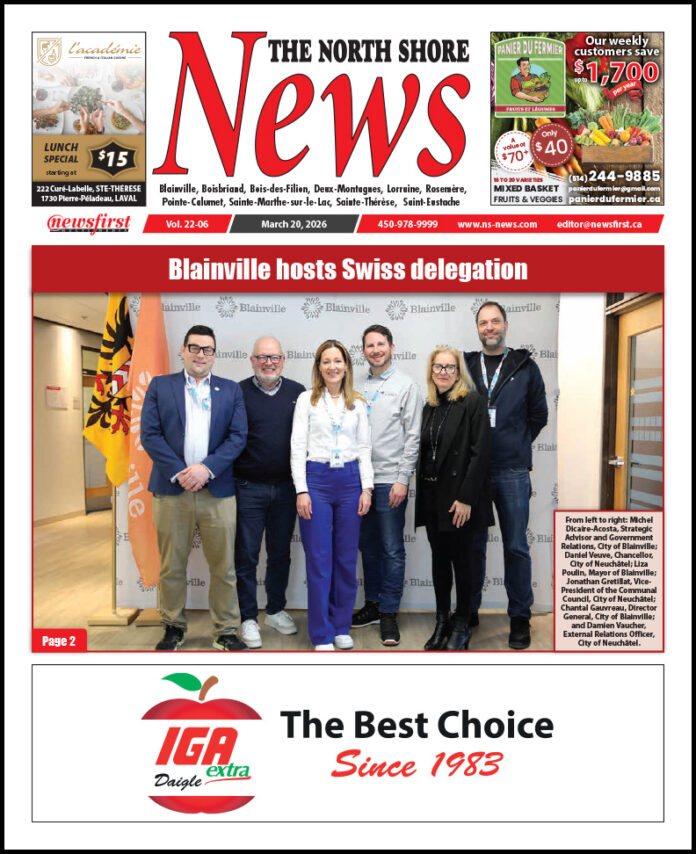
The North Shore News volume 21-20

0

The current issue of The North Shore News volume 21-20 published October 24th, 2025.
Covering North Shore local news, politics, sports and other newsworthy events.

Rosemère marks International Seniors Day with a community brunch

0

The Town of Rosemère marked International Seniors Day on October 1 with a community brunch that brought together local older adults for conversation and information about services available to them. The event was organized by the Town and held in collaboration with Association Horizon Rosemère, the community organization serving residents aged 50 and over.

Announced in September on the Town’s French and English web pages, the invitation specifically welcomed Rosemère residents aged 65 and over to “share a delicious meal in friendly company.” The Town framed the brunch as part of its annual recognition of the international observance, aligning local programming with a broader message of inclusion and well-being for older adults.

Association Horizon Rosemère’s public calendar likewise listed “1er OCTOBRE : BRUNCH DES AÎNÉS (POUR LES CITOYENS DE ROSEMÈRE SEULEMENT)”, confirming the partnership and the audience for the event. Horizon Rosemère is a longstanding community association that offers courses, workshops, social activities and talks for residents aged 50+, and is referenced in Quebec’s public directory of health and social resources.

On the day itself, the Town amplified the message on social media, thanking participants and underscoring the convivial tone of the gathering. Posts on the Town’s official accounts emphasized that the brunch was an opportunity to reconnect, exchange, and discover available community services—consistent with the municipal description on its website.

The timing reflects the United Nations’ International Day of Older Persons, established by the UN General Assembly on December 14, 1990 (Resolution 45/106), and observed each year on October 1. The UN highlights the day as a chance for governments and civil society to recognize older persons’ contributions and to promote policies that support healthy ageing—context that municipalities like Rosemère draw upon when planning local outreach.

While the Town’s notices focus on invitation and appreciation rather than detailed programming, the collaboration with Horizon Rosemère indicates a service-oriented approach: the association’s mandate includes social connection, information sharing, and activities tailored to older adults—elements that typically feature in municipal Seniors Day events across Quebec. The public record for this year’s brunch does not include attendance figures or a full agenda, but the Town’s acknowledgement and Horizon’s listing together verify the date, partners, and purpose of the event.

Weather

Rosemère
broken clouds
7 ° C
7.8 °
6.3 °
75 %
1kmh
75 %
Fri
14 °
Sat
10 °
Sun
11 °
Mon
13 °
Tue
13 °